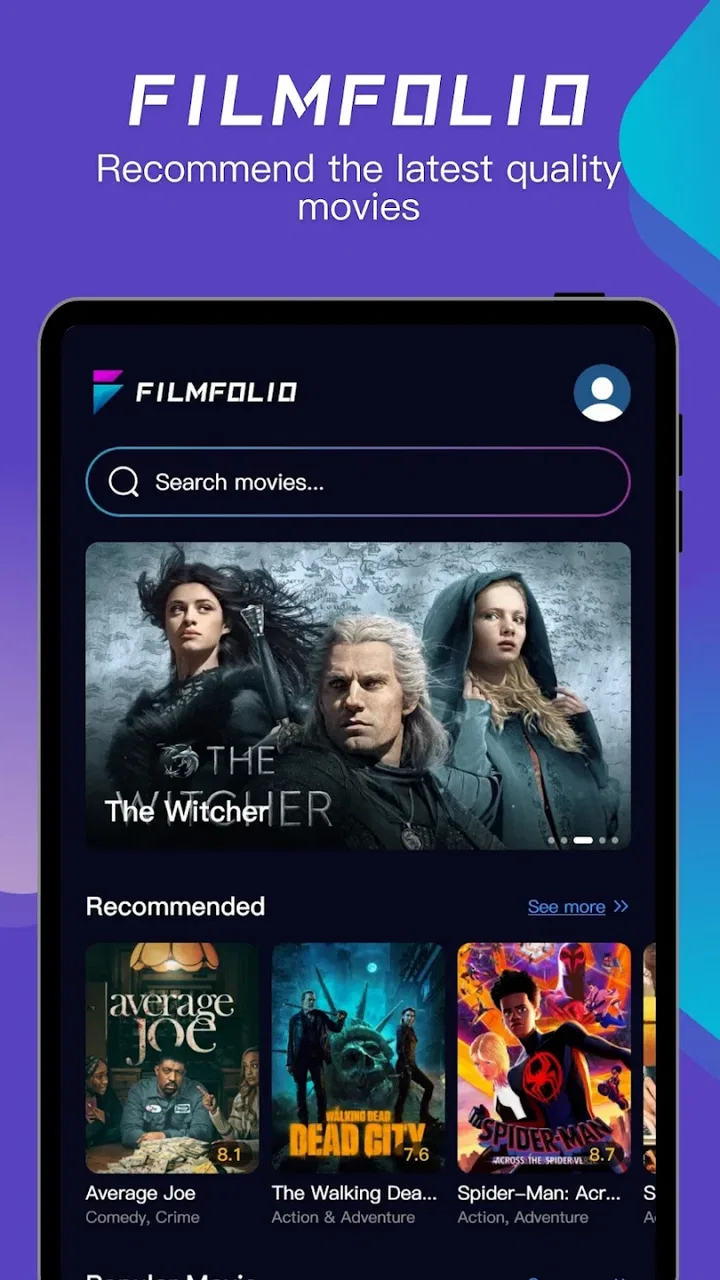
FilmFolio
- 3.9
- Rating
- 100.00K
- Installs
- Free
- Price

 Analysis by App-foxy
I installed FilmFolio expecting a simple way to explore cinema, but I found that its real value depends on how deliberately I use it. It is a free personalization app from LEILEI89, aimed at people who want their film interests to feel more organized and easier to revisit. The basic idea is appealing: instead of relying on scattered notes, memory, or repeated searches, I can keep my attention centered on films and use the app as a personal doorway into the wider world of cinema.
That makes it especially interesting on a shared household device. One person might use it while choosing a weekend film, another might browse it for ideas after dinner, and someone else might simply enjoy looking through cinema-related material during a quiet moment. However, I would not treat it as a complete family media-management system. It is better understood as a personal discovery and personalization tool that can sit on a common tablet or phone, provided everyone understands whose preferences are currently being explored.
How FilmFolio fits into a shared home
In my home, the most realistic use case would be a quick conversation before watching something together. Rather than opening several unrelated services and trying to remember which films caught our attention, I could open FilmFolio and use it as a starting point for discussion. The app’s store summary, “Uncover the World of Cinema,” points toward exploration rather than a full replacement for streaming services, and that distinction matters.
You May Also Like

 Blood Strike: 2.5 Anniversary
Blood Strike’s Loadouts Turn Every Drop Into a Tactical Gamble
A close look at Blood Strike’s custom loadouts: how fast access to signature weapons reshapes its battle royale rhythm, rewards preparation, and narrows the gap between fights.

 Pandora - Music & Podcasts
Pandora’s Music Is Easy to Start, but Harder to Recover
Pandora’s strength is its low-effort path from a seed to a station. Its weak spot is how much confidence it asks you to place in connection, setup, and quiet recovery.

 8 Ball Pool
 Is Built on Rivalries, Rematches, and Routine
A close look at the rivalries, rematches, shared routines, and unanswered safety questions that turn a quick pool match into a persistent mobile community.

 Samsung Music
’s Quiet Strength Is Playing What You Already Own
Its reach comes less from spectacle than from dependable access to a personal library. That simplicity is both the app’s strongest retention engine and its ceiling.

 AccuWeather: Weather Radar
AccuWeather Review: A Quick, Clear Forecast for Everyday Decisions
For everyday plans, the best forecast is the one you can understand quickly. AccuWeather makes rain timing, radar, and local conditions easy to act on, with a few trade-offs.

 Hill Climb Racing
Why Hill Climb Racing Still Turns Crashes Into One More Run
A tiny car, a bumpy hill and one more upgrade: Hill Climb Racing keeps resurfacing because its simple chaos makes every near-miss feel personal.
More From Our News Desk



I would use it during the familiar moment when everyone has time to watch a film but nobody has chosen one. A household member could browse for inspiration, mention a title or theme that looks interesting, and then the group could check where that film is actually available. FilmFolio can help with the discovery part of that process, while another service may still be needed for availability, playback, subscriptions, or parental decisions.
The strongest household benefit is not that it magically solves disagreement. It gives the conversation a shared object. Instead of one person scrolling through an endless streaming home screen while everyone else waits, the group can look at cinema ideas together and narrow the choice. I found that more useful than I expected because choosing a film is often a coordination problem, not a shortage-of-content problem.
There is also a quieter use case. A teenager or adult who enjoys building a mental map of cinema can use the app alone, then bring suggestions to the household later. That makes the experience less demanding than asking everyone to browse at the same time. The trade-off is that the app’s usefulness depends on the user being willing to explore; anyone wanting an instant “play something now” button may find the process less direct.
What I would expect during everyday use
I would not install this expecting FilmFolio to play films itself or to replace every tool used around movie night. Its role is closer to a personalized cinema companion. That makes it useful before viewing, during a conversation about what to watch, or afterward when I want to continue exploring related interests.
A practical routine is to separate discovery from the final decision. I can browse when I have time, keep a short mental or written shortlist, and only later check practical matters such as runtime, language, availability, or suitability elsewhere. This prevents a common frustration: finding an appealing title and assuming the discovery app also handles every step that follows.
For a shared device, I would also avoid leaving the app open at a point that could confuse the next person. If one household member has been exploring a very specific taste, the next user may assume those suggestions represent the whole family. A quick explanation—“these are my cinema interests, not a shared list”—keeps expectations realistic.
Setting up expectations before handing over the device
The first setup decision is not technical; it is about ownership. If I use FilmFolio on my personal phone, the experience can remain tied to my own viewing interests. On a family tablet, I would decide in advance whether the app is being used as one person’s space, a conversation starter for everyone, or a rotating discovery tool. Without that agreement, recommendations and browsing habits can become mixed together in a way that makes the app feel less personal.
I would also explain that a free installation does not necessarily mean every part of the experience is free. FilmFolio is listed as free, while optional in-app purchases range from $1.99 to $49.99 per item. That is a meaningful point for a shared device. Before allowing a child or guest to explore alone, I would check the device’s purchase protections and make sure the household understands that paid items may be available inside the app.
This is not a criticism unique to FilmFolio; it is simply the kind of boundary that matters more when several people use one device. A free app can still present purchase choices, and a child may not distinguish between browsing and spending. I would treat the installation as free to begin with, but I would not leave purchasing decisions undefined.
The app is rated for Everyone, which makes it easier to consider for a mixed-age household. Still, an age label should not replace a parent’s judgement about a particular film topic or the suitability of content discovered through a cinema-focused app. FilmFolio can point attention toward films, but the family remains responsible for deciding what is appropriate to watch and discuss.
Boundaries that make shared use less confusing
My preferred arrangement would be simple: one person browses at a time, the household says out loud when a suggestion is personal rather than collective, and final viewing choices are checked separately. I would not assume that the app creates separate household profiles or automatically keeps everyone’s interests apart. If the device or app offers any account or personalization choices during use, I would read them carefully rather than assuming they work like a streaming service’s profile system.
This boundary is particularly important when a child and an adult share the same tablet. The child may enjoy exploring film ideas, but an adult should still guide the move from discovery to viewing. The app can be part of the conversation without becoming the household’s only filter. In practice, that means checking a film’s subject matter and availability before pressing play somewhere else.
Another useful habit is to avoid treating the app as a record of family consensus. If I browse on behalf of the group, I would say which titles received general approval and which were merely interesting possibilities. That small distinction prevents a later argument when someone assumes that every item seen in the app was already chosen.
For adults sharing a device, privacy is also a matter of courtesy. I would avoid browsing under another person’s identity or presenting their interests as my own. Even without inventing special privacy features, the principle is straightforward: shared hardware does not automatically mean shared taste. Each user should know whether their activity is being treated as personal exploration or as a household list.
Coordination, trust, and the limits of personalization
I find that shared movie choices work better when browsing is treated as a conversation starter, not as proof that everyone has the same taste. A useful habit is to ask each person to explain what caught their attention before the group settles on a film; that keeps curiosity welcome while making room for different comfort levels and expectations.
Using it to reduce the “what should we watch?” problem
FilmFolio works best for me when I use it before the debate becomes tiring. If everyone waits until the exact moment the film should start, browsing can feel like another chore. A better workflow is to explore earlier, select a few possibilities, and bring those choices to the group. The app then supports coordination rather than carrying the entire burden of making a decision.
One non-obvious advantage of this approach is that it separates personal enthusiasm from group practicality. I might discover a film I strongly want to see, while another household member needs something lighter or shorter. FilmFolio can help me articulate the first preference, but the group still needs to negotiate the second. That is healthier than pretending one recommendation will satisfy every person automatically.
I also like the idea of using it as a rotating host tool. One evening, I might choose the discovery theme; another evening, someone else can browse and explain their reasoning. This gives quieter household members a way to contribute without forcing them to compete with whoever controls the streaming remote. The app becomes a prompt for conversation, not merely a scrolling exercise.
There is a trade-off, though. A household that wants synchronized watchlists, shared reminders, or a single obvious queue may prefer a dedicated streaming platform or a list-making service. FilmFolio’s appeal is the cinema exploration itself. If coordination features are the main requirement, I would choose the tool built specifically for shared lists and use FilmFolio alongside it rather than expecting it to do both jobs.
What I would do after finding a promising film
When FilmFolio leads me to an interesting title, I would pause before presenting it as a final recommendation. I would check whether the film is available through a service the household already uses, whether it fits the time available, and whether its subject matter suits the people watching. This extra step is not unnecessary friction; it prevents the disappointment of gathering everyone around a choice that cannot actually be played.
I would also keep a small distinction between “I want to watch this” and “we can watch this tonight.” That sounds obvious, but discovery apps encourage collecting possibilities. A personal cinema list can grow faster than a household can watch anything. If the app inspires many ideas, I would periodically reduce them to a manageable shortlist instead of allowing the list to become another source of indecision.
A second useful workflow is to use FilmFolio after a viewing, not only before one. If a film sparked an interest in a director, period, or style, I could return to the app and explore that direction while the memory is still fresh. This turns a single movie night into a longer learning path through cinema. It is a stronger use than opening the app only when nobody can agree on a title.
Age context and the role of trust
The Everyone rating makes FilmFolio approachable for a broad audience, but I would still maintain an adult checkpoint in a family setting. The app’s purpose is to uncover cinema, and cinema covers many themes even when the discovery tool itself is suitable for general audiences. A parent should decide whether a particular suggestion is right for a child, just as they would with a search engine, catalog, or streaming service.
This is where trust matters more than automation. I would teach younger users to bring unfamiliar suggestions to an adult rather than assuming that an appealing title is automatically suitable. For older children and teenagers, I would use the app as a way to discuss why a film interests them and what they already know about it. That makes the discovery process educational without pretending that a general age label answers every individual question.
I would not choose FilmFolio as the only tool for a household that requires strict, built-in separation between children’s and adults’ media spaces. A service with clearly defined profiles or stronger family-management features may be a better foundation for that need. FilmFolio can complement such an arrangement, but I would not infer account boundaries or parental controls that are not clearly part of the experience.
For trusted adult users, the situation is easier. The app can be shared casually as long as everyone understands that browsing interests may overlap or become mixed. If the household values completely separate recommendations, each person is better off using the app on an individual device or keeping their own cinema notes elsewhere. That is less convenient, but it protects the personal side of personalization.
Where FilmFolio feels stronger than ordinary alternatives
Compared with opening a general web search, FilmFolio feels more focused. A search engine is excellent when I already know the title, actor, or question I want to investigate. It is less satisfying when I want to wander through cinema without forming a precise query. FilmFolio suits that exploratory mood better because the app is built around film discovery rather than asking me to invent the right search words.
Compared with a streaming service’s home screen, it also has a different strength. Streaming recommendations are usually tied to what a service wants to show me and what it can play immediately. FilmFolio is more useful when I want to think beyond one catalog. The weakness is equally clear: after discovering something, I may still need another service to confirm availability and watch it.
Compared with a notes app, FilmFolio offers a more natural cinema context. A blank note gives me total control, but I must create the structure myself. FilmFolio is the better starting point when I want the app to guide my attention toward films. A notes app remains better for a household master list, personal ratings, viewing dates, or detailed plans that FilmFolio may not be designed to manage.
That comparison helped me understand the app’s proper place. It is not the household’s complete media command center. It is a specialized layer for film curiosity. Used that way, it feels purposeful; forced into a role involving playback, family administration, and perfect shared organization, it becomes a less convincing choice.
Performance expectations and practical fit
FilmFolio is currently at version 1.1.3 and supports devices running Android 7.0 or later. That gives it a reasonably broad place on older Android hardware, which is useful if a family keeps a previous phone or tablet for shared entertainment. I would still install it on the device that people actually use, because a broad system requirement does not guarantee that an aging device will feel equally comfortable for browsing.
The app has reached over one hundred thousand installs and holds a 3.9 average from roughly eight hundred ratings, with more than two hundred written reviews. I read that as a sign of a real but not universally loved experience: enough people are using it to establish a pattern, while the rating suggests that expectations should remain measured. I would try it personally before moving it onto the household’s main shared device.
That trial is especially sensible because personalization apps can feel very different depending on how much a user enjoys browsing. Someone who likes discovering connections and building film interests may return often. Someone who wants a direct answer and immediate playback may open it once, find the extra step inconvenient, and go back to a streaming service. Neither reaction is unreasonable; the app simply serves different habits.
Who should install it, and who should skip it
I would recommend FilmFolio to a film-curious person who enjoys exploring beyond the most obvious recommendations. It is also a good candidate for a household that wants a neutral conversation starter before choosing a movie, especially when different people take turns suggesting what to watch. Its free entry point makes experimentation easy, while the Everyone rating removes one initial barrier for mixed-age households.
I would be more cautious if the main goal is a shared, perfectly separated family account. I would also skip it if I needed one app to handle discovery, streaming, parental filtering, synchronized watchlists, and purchase management in one place. A dedicated streaming platform, family organizer, or simple shared note may be more practical for those jobs.
The in-app purchase range is another reason I would establish household rules before handing over the device. Adults can make their own decisions, but children should not be left to interpret purchase prompts without guidance. The app’s free download is attractive, yet the presence of optional paid items means “free” should be understood as a starting point rather than a promise that every interaction has no cost.
My household verdict
After using FilmFolio, I see it as a thoughtful cinema-discovery companion rather than a replacement for the rest of a household’s media setup. Its best contribution is helping people move from vague interest to a more focused conversation: what kind of film sounds good, whose suggestion is it, and what should we investigate next?
The key is to share the device without pretending that every preference is shared. I would keep personal browsing separate in spirit, explain purchase boundaries, and use adult judgement when children are involved. With those expectations in place, the app can make movie selection feel less random and give a curious user a reason to keep exploring after the credits.
My final recommendation is positive but specific. Install it if you want a focused way to uncover cinema ideas and you are comfortable completing the practical steps elsewhere. For a household, use it as a discussion and discovery layer, not as the authority on what everyone should watch. That modest role is exactly where FilmFolio feels most convincing: personal enough to reward curiosity, and flexible enough to bring a few different tastes into the same room.
FAQs for FilmFolio
01What is FilmFolio, and how does it enhance my movie-watching experience?
FilmFolio is a comprehensive app designed to enhance your movie-watching experience by offering curated recommendations, detailed film information, and personalized watchlists. It features a sleek interface that allows users to discover new films, read reviews, and connect with fellow movie enthusiasts. Whether you’re a casual viewer or a cinephile, FilmFolio provides tools to enrich your cinematic journey.
02Is FilmFolio available on both Android and iOS devices?
Yes, FilmFolio is available for download on both Android and iOS platforms. The app is optimized for a seamless experience on smartphones and tablets, ensuring that users can access all features regardless of their device. You can find FilmFolio on the Google Play Store and the Apple App Store, making it widely accessible to movie lovers everywhere.
03Does FilmFolio require a subscription, or is it free to use?
FilmFolio offers a free version with access to essential features such as movie recommendations and basic watchlist creation. However, there is also a premium subscription option that unlocks additional features like advanced search filters, exclusive content, and an ad-free experience. This allows users to choose the level of access and functionality that best suits their needs.
04How does FilmFolio curate its movie recommendations?
FilmFolio uses a combination of algorithms and user input to curate personalized movie recommendations. It considers your viewing history, ratings, and preferences to suggest films you might enjoy. Additionally, the app incorporates reviews and ratings from a community of users to provide a well-rounded suggestion list, making your next movie night decision easier and more enjoyable.
05Can I connect with other users on FilmFolio to discuss movies?
Yes, FilmFolio includes social features that allow users to connect with others, share reviews, and discuss films. You can follow friends, join movie discussion groups, and even participate in forums dedicated to specific genres or directors. This interactive aspect of FilmFolio fosters a community of movie lovers, enhancing your overall experience by enabling shared discussions and insights.
Pros
- Intuitive user interface for easy navigation.
- Wide range of editing tools available.
- Supports high-resolution video exports.
- Regular updates with new features.
- Seamless integration with cloud services.
Cons
- Occasional slow performance on older devices.
- Limited free version features.
- In-app purchases can be pricey.
- Requires a stable internet connection.
- Some features have a steep learning curve.

FilmFolio
Gallery